
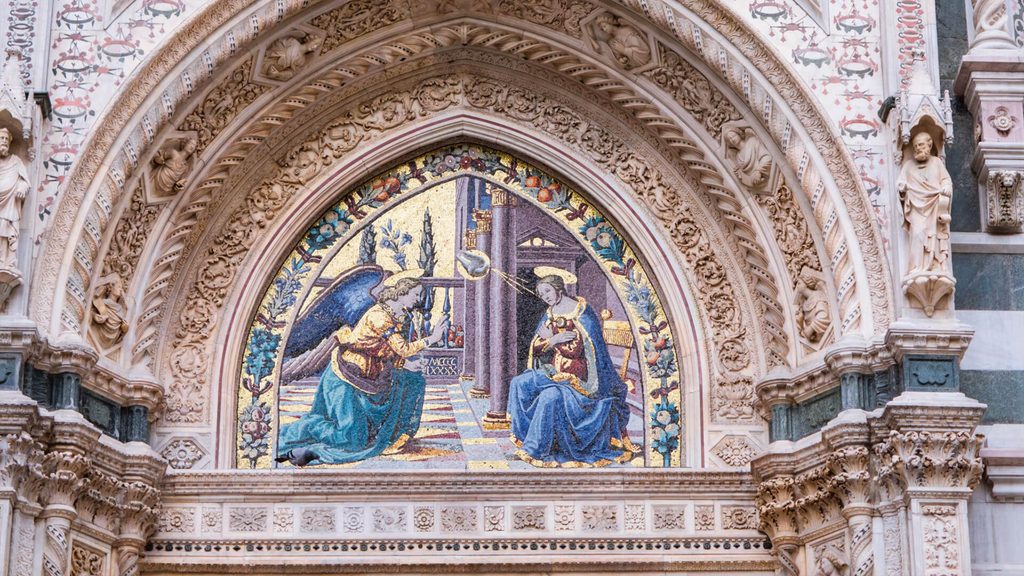
In the late fifteenth century, Domenico Ghirlandaio was one of the most admired fresco painters in Florence. Yet, according to Giorgio Vasari, he used to say that painting is drawing, and that the true painting for eternity is mosaic. Ghirlandaio did not only talk about it: the Annunciation mosaic in the lunette of the Porta della Mandorla of Florence Cathedral, created on his design with his brother David, still shines above the entrance today.
That old remark still makes sense today, though not as a verdict on which art is better. Painted murals and mosaics have shared walls, churches, and palaces for centuries, and each has its own qualities. Comparing mosaic VS mural is really a way of understanding how an image is made, how it lives with light and use, and which approach suits a particular space.
Mosaic VS mural: a question of how an image is built
A painted mural is made of pigment. Whatever the technique, from traditional fresco on wet lime plaster to modern acrylics, the image is spread across the surface in continuous strokes. Colour can be blended endlessly, lines can be as fine as the brush allows, and the painter can work directly on the wall, adjusting the composition as it grows.
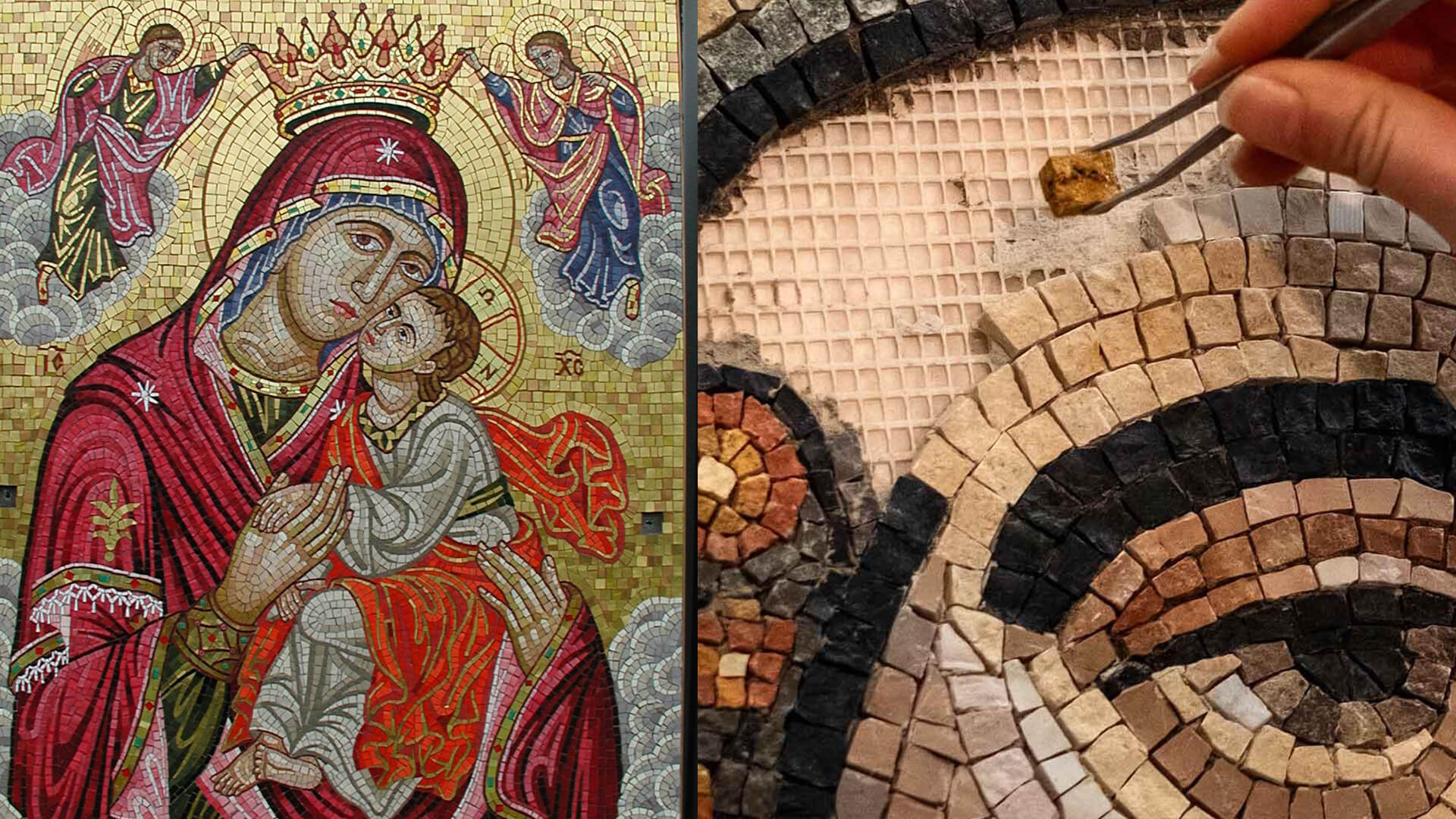
Mosaic builds an image from matter. Each tessera of glass, stone, or ceramic is a small, solid unit of colour, and the picture emerges from how thousands of these units are cut, placed, and combined. Instead of blending, the mosaicist creates transitions by setting tones side by side, relying on the eye to merge them from a distance. The direction in which the tesserae are laid, known as andamento, becomes part of the drawing itself, guiding the gaze along a figure, a wave, or a curve.
This difference shapes the whole process. A mural can be painted directly on site, while a mosaic is often composed in the studio, from a full-scale drawing, and then installed in sections. The first is closer to the gesture of a brush; the second is closer to architecture, since the image is quite literally constructed.
Light, texture, and the passing of time
The most visible difference between the two appears when light moves across the wall. Paint generally absorbs and diffuses light, producing a soft and even surface. Mosaic, especially when made with glass, reflects it. Hand-poured smalti and Murano glass tesserae are set at slightly different angles, so each piece catches light in its own way. As the day changes, or as a person walks past, the surface seems to shift, gaining depth and vibration.
Texture follows the same logic. A mural is usually smooth to the touch, while a mosaic has a relief, however subtle, created by the tesserae and the grout lines between them. That relief can be emphasised for a more expressive effect, or kept minimal for a refined, almost polished surface. Designers often use these qualities strategically, choosing reflective or matte materials to modulate brightness and glare, a theme we explored in our article on custom mosaic design as an architectural problem-solver.
Time also treats the two techniques differently. A mural may need retouching or restoration over the years, particularly in busy areas, and this can be part of its charm, since it allows the image to be refreshed or even reimagined. The colours of glass and stone, by contrast, are part of the material itself, so a well-made mosaic keeps its original palette with simple, regular care.
The mosaic fireplace surround: where the surface has to work
Some areas of a home ask more of a surface than others, and the fireplace is one of the clearest examples. Warmth, soot, and frequent cleaning all take place within a small area, which also happens to be the natural focal point of the room. Around a fireplace, a painted finish may discolour or require frequent maintenance, while a mosaic fireplace surround handles these conditions with ease.
Glass and natural stone tolerate the warmth of the surround, can be cleaned without affecting their colour, and keep their brilliance after years of use. From a design perspective, the surround offers a beautiful canvas: a frame of marble tesserae with a glass border, an abstract composition that echoes the flames, or a figurative motif that extends upward onto the chimney breast. Glass is particularly effective here, as its reflections come alive with the firelight in the evening.
Technical planning matters just as much as the design. The studio will consider the type of fireplace, the required clearances, and the substrate, and the installation should use materials suited to heat, always in line with the manufacturer’s specifications and local regulations. When these aspects are handled from the start, the surround becomes both a practical solution and a piece of art at the centre of domestic life.
Mosaic mural art: when the two languages meet
The comparison between mosaic and mural is not always a matter of choosing one over the other. Mosaic mural art brings them together, combining the scale and narrative ambition of a painted mural with the materials and permanence of mosaic. Large figurative scenes, landscapes, and abstract compositions that might once have been painted can be translated into tesserae, creating works that cover entire walls, lobbies, or façades.
This translation is an art in itself. A painted design cannot simply be copied piece by piece; it needs to be reinterpreted. Gradients are rebuilt through carefully chosen tones, brushstrokes become directions of laying, and details are adjusted to the size of the tesserae and the distance from which the work will be seen. The mosaicist becomes a kind of interpreter, working alongside the artist, the architect, or the client to preserve the spirit of the original while making the most of the new medium.
This collaborative role is at the heart of the work of a custom mosaic artist in architectural design, where vision and craftsmanship have to meet within the constraints of a real space. History offers many examples of this dialogue, and Ghirlandaio’s own career, moving between fresco and mosaic, is one of the most eloquent.
Choosing the right language for your space
Deciding between a mosaic and a painted mural starts with a few simple questions. Will the surface be touched, cleaned, or exposed to heat and moisture? How will natural and artificial light fall on it? Is the image meant to change over time, or to remain as a lasting part of the architecture? A mural can be the right choice for a project that values speed, flexibility, or the immediacy of the brush, while mosaic is ideal when the image needs to become part of the building itself.
In many projects, the two can even coexist, with a painted ceiling above and a mosaic wall or fireplace below. What matters is choosing each technique for what it does best. More than five centuries after Ghirlandaio, the conversation between paint and tesserae continues, and every new wall is an opportunity to decide how an image should be built, how it should meet the light, and how long it should be part of the story of a space.